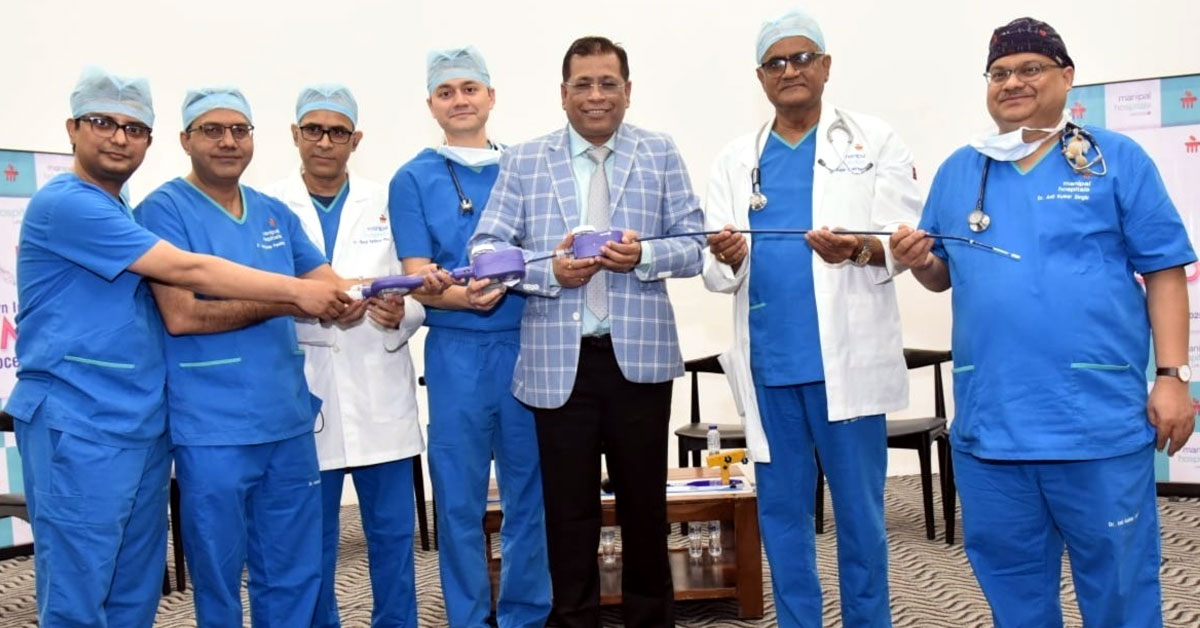
Kolkata: Manipal Hospital, EM Bypass—part of the Manipal Hospitals Group, one of Eastern India’s largest healthcare providers—has achieved a major milestone in advanced cardiac care with the successful implantation of Eastern India’s first indigenously manufactured MyCLIP TEER heart device. The life-saving procedure was performed on November 29, 2025, on a 60-year-old patient from Asansol, who was deemed extremely high-risk for conventional open-heart surgery.
The landmark intervention was led by Dr. Dilip Kumar, Director – Cath Lab, Senior Interventional Cardiologist, and Structural Heart Expert at Manipal Hospital, EM Bypass. He was supported by a multidisciplinary team comprising Dr. Prakash Kumar Hazra, Director & Head of Cardiology, Manipal Hospital, Dhakuria; Dr. Rabin Chakraborty, Senior Consultant – Cardiology; and Dr. Anil Kumar Singhi, Senior Consultant – Paediatric Cardiology, Manipal Hospital, EM Bypass.
The patient, Ramswaroop, a small business owner, was suffering from severe mitral regurgitation, dilated cardiomyopathy with a critically reduced Left Ventricular Ejection Fraction (LVEF) of 25%, pulmonary hypertension, minor coronary artery disease, and hypertension. He had previously been admitted with advanced heart failure and severe anasarca, leaving surgical valve replacement a prohibitively high-risk option.
The MyCLIP Transcatheter Edge-to-Edge Repair (TEER) System, a Made-in-India innovation developed under the Government of India’s Make in India initiative, offered a viable alternative. Until recently, the technology was available globally from only two manufacturers, with total treatment costs approaching ₹30 lakh. Indigenous manufacturing by Meril has reduced the cost by nearly 50% to approximately ₹15 lakh.
However, given the patient’s financial limitations and absence of public insurance coverage, the device manufacturer extended further support through a CSR initiative, reducing the cost by over 50%. Additional assistance from the Manipal Foundation and a city-based social organisation ensured that the patient faced no additional financial burden, enabling access to the advanced therapy.
Mitral regurgitation, if left untreated, carries a grim prognosis, with studies indicating that over 50% of patients may not survive, and a one-year mortality rate of up to 57%. The MyCLIP TEER system offers a minimally invasive approach, repairing the mitral valve through a small puncture in the leg vein. The procedure typically lasts about an hour, allows discharge within 3–5 days, and enables a rapid return to daily activities.
During the procedure, the MyCLIP (LW-12/6) device was successfully implanted, reducing valve leakage from severe to trivial levels. The patient showed immediate clinical improvement, with significant relief from breathlessness, chest discomfort, and sleep disturbances. He was discharged in a stable condition within two days and has since resumed his business activities.
Explaining the significance of the procedure, Dr. Dilip Kumar said:
“Severe mitral regurgitation can drastically reduce both the quality and expectancy of life, especially in patients with multiple co-morbidities and severely compromised heart function. In this case, open-heart surgery carried an extremely high risk. MyCLIP TEER offered a minimally invasive yet effective solution. Successfully performing Eastern India’s first MyCLIP implantation is a major clinical milestone and reinforces the effectiveness of indigenously developed cardiac devices. Equally important was ensuring access despite financial constraints, made possible through the combined support of Meril, the Manipal Foundation, and several NGOs. I would also like to acknowledge the valuable support of Dr. Sumanto Mukhopadhyay, a senior and respected cardiologist from Kolkata, throughout the procedure.”
Sharing his experience, Ramswaroop said:
“Before this procedure, every breath felt like a struggle. Even lying down to sleep was frightening. I had almost accepted this as my fate. After the MyCLIP procedure, the change has been miraculous. I can breathe easily, sleep peacefully, and feel my strength returning. I am deeply grateful to Dr. Dilip Kumar and the entire team at Manipal Hospital, EM Bypass, for giving me a second chance at life.”
This landmark achievement not only marks a clinical first for Eastern India but also underscores how indigenous medical innovation, combined with institutional and social support, is transforming access to life-saving cardiac care for high-risk patients once considered untreatable.