
Kolkata: As India’s digital economy expands, the amount of data generated by individuals, businesses and public institutions is growing rapidly. From digital payments and smartphone photos to hospital records and government services, almost every digital activity depends on the ability to securely store, process and access data.
What is Cloud?
Cloud computing is a digital infrastructure that allows organisations to store, process, manage and retrieve data using powerful servers housed in secure data centres. Instead of depending entirely on local devices or on-premise servers, organisations can use remote cloud infrastructure to run applications and manage data.
The cloud can be compared with a digital warehouse. While a physical warehouse stores goods, cloud infrastructure stores data, runs applications, maintains backups and enables authorised access from different locations. Banks, hospitals, businesses and government agencies increasingly depend on cloud services for critical operations.
Why is Data Protection Important?
As more personal and business activities move online, protecting data has become a key priority. Personal information, financial records and business data need protection against theft, misuse, unauthorised access and loss.
A data breach can lead to identity theft, financial fraud, loss of customer confidence and disruption of essential services. Strong data protection measures help ensure that information remains secure, accurate and available when required.
The growing threat from spam, phishing and online fraud has also increased the need for stronger digital security. Telecom operators are increasingly deploying artificial intelligence-based solutions to identify and block such threats. Airtel, for instance, says its AI-led anti-spam solution has identified more than 93 billion spam calls and 4 billion spam messages, while blocking over 1.4 million fraudulent links.
What is Sovereign Cloud?
A sovereign cloud is a cloud environment designed to ensure that data, infrastructure and cloud operations remain within a country’s legal and regulatory jurisdiction.
For India, this means sensitive data can be stored, managed and governed under Indian laws and applicable security frameworks. The concept is similar to keeping important documents in a bank locker located within the country rather than placing them under the jurisdiction of another nation.
Sovereign cloud, however, is not limited to the physical location of data. It can also involve control over metadata, backups, encryption keys, access permissions and cloud-management systems. This gives organisations greater control over sensitive information while helping them meet regulatory and compliance requirements.
How Does Keeping Data in India Help?
Keeping data within India can provide organisations with greater legal, regulatory and operational control. It can improve visibility into where information is stored, how it is processed and who has access to it.This is particularly important for sectors such as banking, healthcare, government, taxation, defence and critical infrastructure, where data security and regulatory compliance are especially important.
Domestic data hosting can also reduce exposure to foreign legal jurisdictions and help organisations align their technology infrastructure with India’s evolving data-governance requirements.
Airtel’s Sovereign Cloud Push
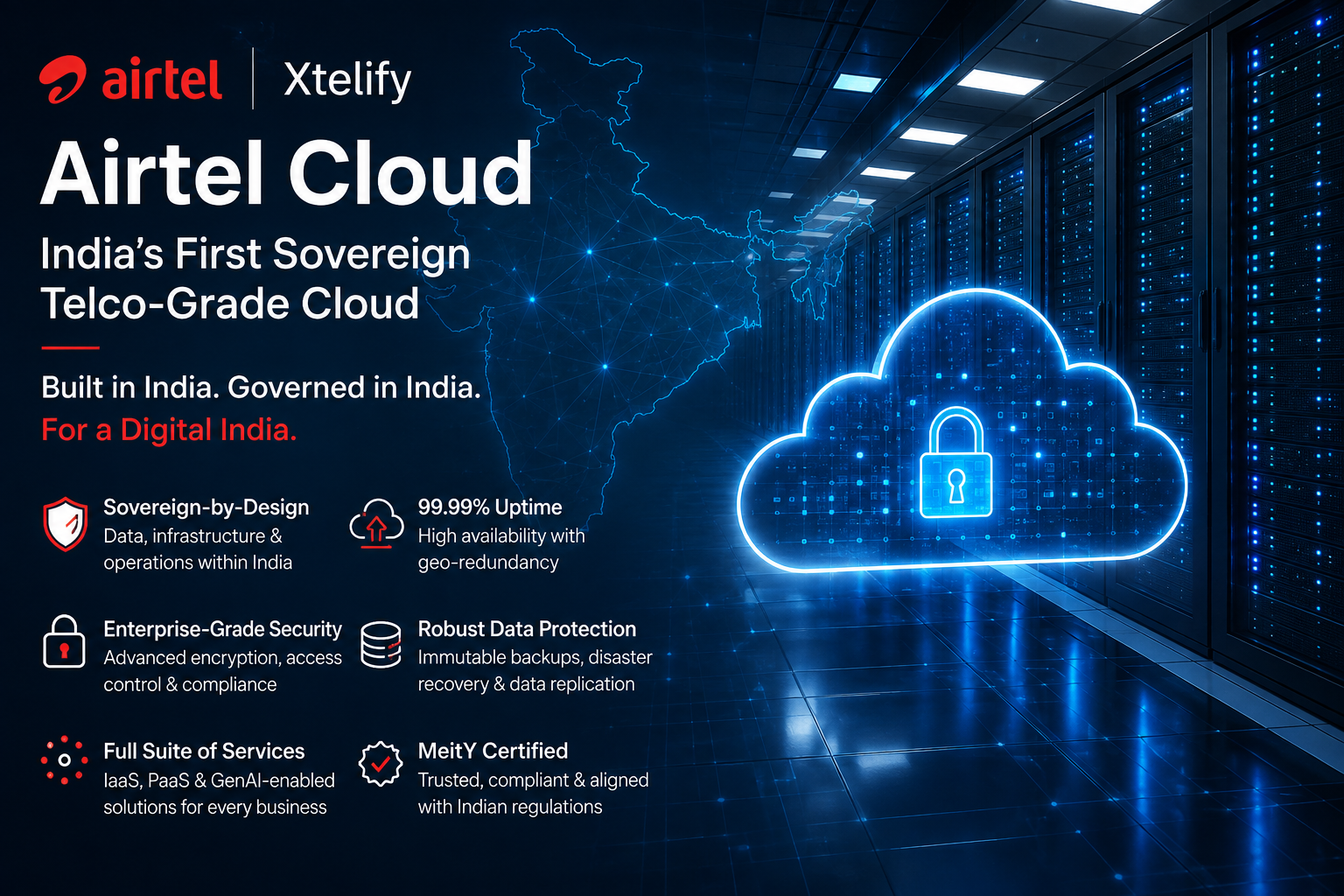
Airtel has entered the sovereign cloud space with Airtel Cloud through Xtelify, launched in August 2025. The company describes it as India’s first sovereign, telco-grade cloud platform offered by a telecom operator.
Originally developed to support Airtel’s own digital ecosystem, the platform has been designed to handle large-scale workloads, with Airtel stating that it is capable of supporting up to 1.4 billion transactions per minute.
According to Airtel, its sovereign-by-design architecture keeps data, infrastructure and control-plane operations within India. The platform is built on Airtel’s data centres and nationwide network and offers features including 99.99% uptime, geo-redundancy, disaster recovery, immutable backups and continuous data replication.
Airtel Cloud offers Infrastructure as a Service (IaaS), Platform as a Service (PaaS) and GenAI-enabled services. These capabilities are aimed at enterprises and government organisations that need to run mission-critical workloads while maintaining greater control over their data.
With its focus on locally governed infrastructure, sovereign cloud is emerging as an important component of India’s digital infrastructure. As businesses and public services become increasingly dependent on cloud technology, ensuring that critical data remains secure, accessible and subject to Indian governance could become increasingly important.
For India, therefore, sovereign cloud is not simply about where data is stored. It is about who controls the infrastructure, who governs access to the data and which legal framework ultimately applies to it.