Bengaluru centre records 2,500+ total bone marrow transplants and 228 paediatric BMTs in a single financial year
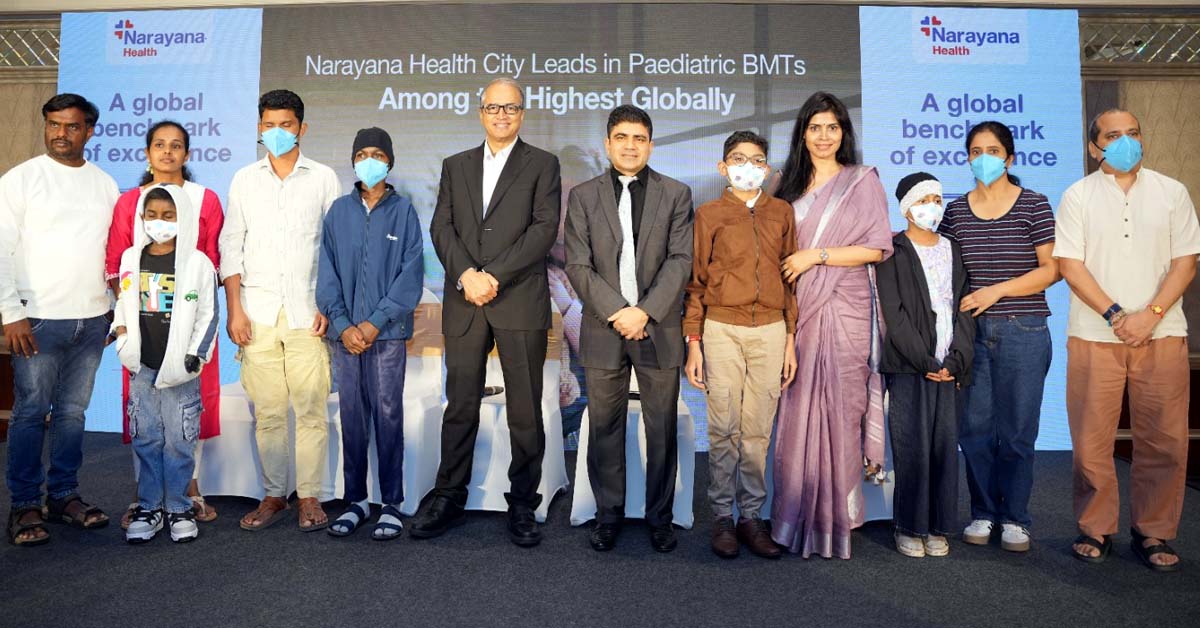
Bengaluru : Finding a suitable bone marrow donor remains one of the biggest challenges for children requiring a transplant. Addressing this critical gap, Narayana Health City has crossed the landmark of 1,000 paediatric haploidentical, or half-matched, bone marrow transplants, becoming the only hospital in India to achieve the milestone and recording the highest volume of paediatric haploidentical transplants in Asia.
The centre has also crossed 2,500 bone marrow transplants overall, covering both paediatric and adult patients.
Adding another significant achievement, Narayana Health City performed 228 paediatric bone marrow transplants in a single financial year, making it one of the highest-volume centres globally and the only hospital in India to report such a scale within one financial year.
The programme is led by Dr Sunil Bhat, Vice Chairman, Oncology Collegium, Director & Clinical Lead, Paediatric Hematology, Oncology and Paediatric Bone Marrow Transplant, Narayana Health City.
The achievement assumes greater significance because many children requiring a transplant do not have a fully matched donor. According to the hospital, only around 25–30% of patients are likely to have a fully matched sibling donor, while another 10–15% may potentially find a suitable matched unrelated donor through donor registries, depending on their HLA profile and donor availability.
For the remaining patients, a haploidentical transplant, in which a family member is only a half match, can provide a potentially life-saving alternative.
Turning a half-match into a second chance
A parent is generally a half-match for their child, while siblings can also be potential half-matched donors. However, haploidentical transplantation remains a technically complex procedure requiring specialised protocols, experienced clinicians, advanced laboratory support and intensive monitoring before and after transplantation.
Narayana Health City’s paediatric BMT programme treats children with a wide range of serious blood disorders, including thalassemia, leukaemia and aplastic anaemia.
The need for such treatment is particularly significant in India, where the burden of thalassemia and other paediatric blood disorders remains substantial.
Dr Devi Shetty, Founder and Chairman, Narayana Health, said that a child should not lose the chance of survival simply because a perfect donor match is unavailable.
He emphasised that the hospital has worked over the years to build a programme where the absence of a perfect match does not mean the absence of hope for a child.
2,500th patient marks another milestone
Among the patients who reflect this journey is Shirin (name changed), a young girl from Jammu and Kashmir, who became the 2,500th patient to undergo a bone marrow transplant at Narayana Health City.
With no fully matched donor available, she underwent a haploidentical bone marrow transplant using a half-matched family donor. Her case highlights how advances in haploidentical transplantation are expanding treatment options for children who may otherwise have limited donor choices.
11-year-old boy battles relapsed leukaemia
Vipin (name changed), an 11-year-old boy with B-cell acute lymphoblastic leukaemia (B-ALL), suffered a relapse in both the bone marrow and testes after completing his initial treatment.
Following further intensive therapy, he underwent a haploidentical stem cell transplant with his father as the donor.
His recovery was complicated by infections and skin graft-versus-host disease. Despite these challenges, he achieved successful engraftment and, more than a year later, continues to recover well under regular medical follow-up.
Father becomes donor for teenager with aplastic anaemia
Ashutosh (name changed), a 15-year-old from Chhattisgarh, was diagnosed with severe aplastic anaemia, a serious and potentially life-threatening blood disorder.
As his condition progressed, he became dependent on regular blood transfusions and was referred for a stem cell transplant. Since no fully matched donor was available, his father became his half-matched donor.
Despite challenges during treatment, Ashutosh successfully underwent the transplant, achieved engraftment and is currently doing well under regular follow-up.
Seven-year-old Mayank overcomes complex blood cancer journey
Another case is that of Mayank (name changed), a seven-year-old from Tumakuru, who had been battling CALLA-positive B-cell acute lymphoblastic leukaemia since January 2023.
In November 2025, he experienced an unexpected lineage switch and developed acute myeloid leukaemia (AML).
On March 4, 2026, Mayank underwent a TCR alpha-beta depleted haploidentical stem cell transplant, with his father serving as his 6/12 HLA-matched donor.
The child faced several serious post-transplant complications, including febrile neutropenia, mucositis and acute kidney injury. However, the graft successfully engrafted, with neutrophil recovery on Day +11 and platelet recovery on Day +12.
More than a decade of paediatric transplant experience
Built over more than a decade, Narayana Health City’s paediatric BMT programme now offers both full-match and haploidentical transplant options, enabling children to access transplantation even when a fully matched donor is unavailable.
Dr Sunil Bhat said the significance of performing 228 paediatric transplants in a single financial year goes beyond the number itself, as every transplant represents a child and family placing their trust in the medical team.
He added that more than 1,000 paediatric haploidentical transplants have helped the team develop extensive expertise in managing this complex procedure.
The hospital said its achievements are supported by internal transplant data, contributions to the ISBMT Registry and documentation through BMT+ software systems.
For families facing the daunting challenge of finding a bone marrow donor, the message from Narayana Health City’s experience is clear: a perfect donor match may not always be necessary for a child to get a second chance at life.