

Kolkata: The message of women’s strength took a different turn in Kolkata this festive season. Alongside the familiar celebration of feminine power, doctors at Manipal Hospital EM Bypass used the occasion to talk about a battle that affects thousands of women—the battle against breast cancer.
The hospital’s Breast Cancer Awareness Month initiative, themed ‘Durgatinashini – You are your own’, focused on a simple but important message: women should not wait for a serious symptom or a diagnosis before taking charge of their breast health.
The campaign brought together doctors, media representatives and prominent women, including filmmaker and screenwriter Nandita Roy and model Richa Sharma, to discuss breast health, early detection and the importance of seeking medical advice without delay.
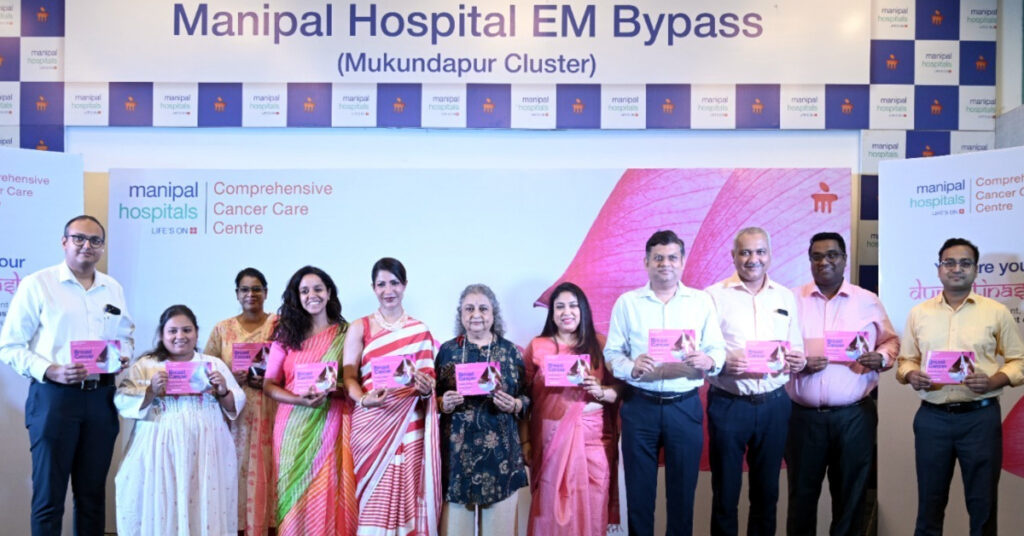
The idea behind ‘Durgatinashini’ was not merely to portray women as fighters after cancer has been diagnosed. Instead, the campaign attempted to bring attention to the role women can play much earlier—by knowing their bodies, noticing unusual changes and taking the decision to consult a doctor.
‘The first step begins with you’
Speaking at the programme, Dr Neha Choudhary, Senior Consultant and Department Head, Surgical Oncology (Breast Surgery), Manipal Hospital, Mukundapur Cluster, said the campaign was about changing the way breast cancer is viewed.
According to her, the strength associated with the idea of ‘Durgatinashini’ should also translate into taking responsibility for one’s own health. She stressed that while medical treatment remains central to cancer care, emotional and social support can make a major difference to a patient’s journey.
For many patients, the difficult part begins even before treatment—with fear, uncertainty and the emotional impact of a diagnosis. Support from family members, friends and caregivers can therefore become an important source of strength during treatment and recovery.
Doctors warn against waiting for symptoms to become serious
One of the strongest messages from the event was the need for early detection.
Dr Pooja Agarwal, Consultant – Surgical Oncology (Breast Surgery), Manipal Hospital EM Bypass, said women above the age of 40 should undergo an annual mammogram, while younger women should remain alert about changes in their breasts and practise regular self-breast examination.
She also pointed towards a worrying pattern in India—many patients reach hospitals when the disease has already progressed.
Cultural barriers, lack of awareness and hesitation in seeking medical advice can all contribute to delayed diagnosis. By the time some patients reach a cancer centre, the treatment journey can become considerably more complicated.
Dr Agarwal stressed that breast cancer treatment cannot be reduced to a single procedure. Diagnosis, staging, surgery and other forms of therapy need to be planned according to the individual patient, often with inputs from a multidisciplinary team.
But medical treatment is only one part of the journey.
Nutrition, self-care, emotional well-being and the involvement of family members can also influence how a patient copes with the disease and returns to everyday life.
From fear to confidence
The campaign also tried to move the conversation around breast cancer away from fear.
Cancer survivors often speak not only about the treatment they underwent, but also about the psychological battle that accompanies the diagnosis. Regaining confidence, receiving reassurance and having people around them who understand what they are going through can be just as important in helping patients return to normal routines.
Dr Sourav Datta, Director, Manipal Comprehensive Cancer Care Center, Broadway and Mukundapur Cluster, Kolkata, said breast cancer awareness should not remain restricted to October.
The real objective, he suggested, is to make women more familiar with their own bodies so that a change does not go unnoticed. Early detection, timely medical advice and appropriate treatment can significantly influence the course of the disease.
Breast cancer is not only a women’s issue
There was another important reminder during the discussion—breast cancer, although overwhelmingly associated with women, can affect men as well.
The experience of 62-year-old Kolkata resident Ashok Chakraborty brought that point home.
His journey began after he noticed a hard lump on the right side of his chest. After consulting doctors, he was initially put on hormone therapy to see whether the growth would respond. Although there was a positive response, the lump did not disappear completely.
Doctors subsequently recommended a radical mastectomy.
Chakraborty is now recovering well and has returned to his normal routine while continuing his prescribed medication and hormone therapy.
His story underlines a message that doctors want people to remember: an unusual lump or change in the breast or chest should never simply be ignored because of gender.
Awareness before treatment
The larger message emerging from the Manipal Hospital initiative was perhaps simpler than the medical terminology surrounding cancer.
Breast cancer awareness does not begin inside an oncology department. It begins with awareness of one’s own body.
A lump, a visible change, an unusual alteration in the breast or any other persistent concern may not necessarily mean cancer—but it deserves medical attention rather than postponement.
And that is where the idea of ‘Durgatinashini’ finds its relevance: not only in the courage to fight cancer, but in having the courage to notice, question and act early.

