
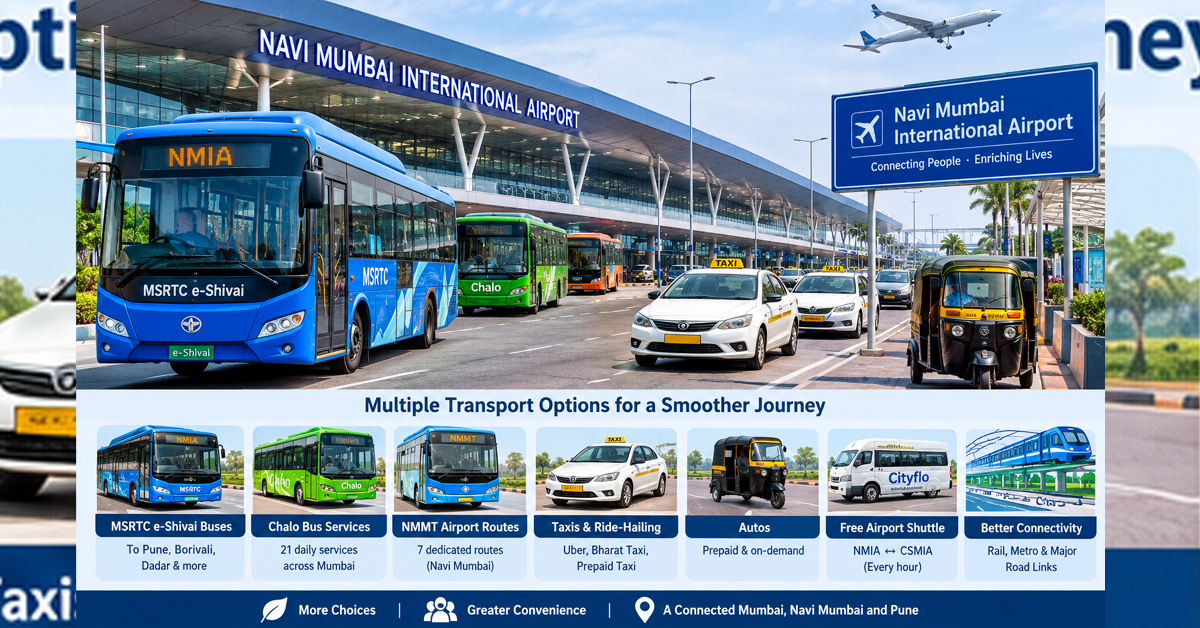
Mumbai: Getting to and from Navi Mumbai International Airport (NMIA) is set to become easier as more buses, taxis, autos and shuttle services are being added to the airport’s growing transport network.
With the winter flight schedule set to begin on October 25, the airport is preparing to handle increased passenger movement by expanding public transport and last-mile connectivity across Mumbai, Navi Mumbai, Pune and other parts of the Mumbai Metropolitan Region.
For passengers, the biggest change is the growing number of choices. Depending on where they are travelling from, they can now look at state-run electric buses, municipal buses, app-based cabs, prepaid taxis, autorickshaws, rental cars and even a free shuttle connecting Navi Mumbai airport with Mumbai’s existing international airport.
Pune trip for ₹450, Dadar for ₹170
One of the more affordable options is the new MSRTC e-Shivai electric bus service, which is scheduled to start from October 7.
A ride from NMIA to Pune will cost ₹450, while the fare to Borivali is ₹210 and Dadar East ₹170.
There is also a concession for certain passengers. Children below 12 years and women travelling with a National Common Mobility Card will be eligible for half-fare.
The first phase of the MSRTC service will connect the airport with Dadar, Borivali and Pune. The buses will operate from early morning until late at night.
The Dadar route will travel through Sion and Atal Setu, while the Borivali service will connect the airport with CSMIA Terminal 1, Bandra and Atal Setu.
For Pune passengers, there will initially be two daily services—one in the morning and another in the afternoon.
More routes are expected to follow. Services linking NMIA with Thane and Nashik are planned for the middle of November.
21 Chalo buses connect Mumbai
For passengers travelling from Mumbai, Chalo Bus is another option.
The operator currently has 21 daily services connecting NMIA with Marol in Andheri East, Bandra, Dadar and the World Trade Centre area in Colaba.
The buses are scheduled to operate at regular intervals during both peak and non-peak hours. Additional capacity is also being planned for periods when passenger and airport staff movement increases.
NMMT adds seven airport routes
Navi Mumbai residents will have access to seven dedicated Navi Mumbai Municipal Transport (NMMT) routes.
The A1 to A7 services connect Terminal 1 with Kharkopar, Targhar, Belapur, Nerul, Panvel, Khandeshwar and the Airport Project Office.
Belapur and Nerul have more frequent services, with buses running roughly every 15 to 20 minutes during peak hours.
More connectivity towards Vashi and Panvel is also being planned.
More choices for passengers who prefer cabs
Passengers who do not want to depend on bus timings will have several taxi and ride-hailing options.
Uber Go and Uber Premier will operate from designated pickup areas at the airport, while Uber Auto will cater to passengers looking for a short-distance ride.
Prepaid taxis and prepaid autorickshaws will also be available, along with car rental services.
Another addition is Bharat Taxi, which is expected to begin operations from October 10 with a dedicated fleet of up to 40 vehicles.
Free shuttle between Mumbai’s two airports
For passengers who need to transfer between Mumbai’s two airports, one service could prove particularly useful.
A complimentary shuttle will run every hour between NMIA and Chhatrapati Shivaji Maharaj International Airport (CSMIA).
The service will be operated jointly by Cityflo, Aarya and Chalo, providing passengers with a direct transfer option between the two airports.
For travellers arriving at one airport and departing from the other, the shuttle is expected to offer an alternative to arranging a separate taxi or private vehicle.
Nearly 4,600 vehicles and buses in the transport network
The airport is also scaling up its overall ground transport capacity.
The combined network of app-based taxis, rental cars, autorickshaws and buses is expected to have a capacity of 4,594 vehicles and services, including:
- 3,787 app-based taxis
- 184 rental cars
- 171 autorickshaws
- 547 buses
Inside the airport, separate areas are being arranged for buses, shuttles, arrivals, departures and private vehicles. Signage and passenger wayfinding systems are also being expanded to help travellers find their transport without having to navigate through the terminal area unnecessarily.
Rail and road links continue to expand
NMIA is also connected to the suburban railway network through Panvel, Targhar and Bamandongri stations.
By road, the airport can be accessed through major routes including Atal Setu, Sion-Panvel Highway, Palm Beach Road, Amra Marg (NH-348A) and NH-548.
Navi Mumbai Metro Line 1 is already operational, while the proposed Mumbai Metro Line 8 is expected to eventually provide a direct metro connection between CSMIA and NMIA.
The airport is also working with the Adani TotalEnergies Gas (ATGL) team to expand electric vehicle charging infrastructure, another part of the airport’s effort to build a larger and more sustainable ground mobility network.
A wider transport net as flights increase
As NMIA enters its next phase of operations, the focus is increasingly shifting beyond the terminal itself.
For passengers, an airport is only as convenient as the roads, buses, taxis and public transport that connect it to the city. With more MSRTC, NMMT and private bus services, additional taxi and auto options, and a free hourly connection to CSMIA, NMIA is building a wider transport network ahead of the winter schedule.
The real test, however, will come as passenger numbers rise and more flights begin operating. For now, the growing list of transport choices gives travellers across Mumbai, Navi Mumbai and Pune more ways to reach the new airport.