
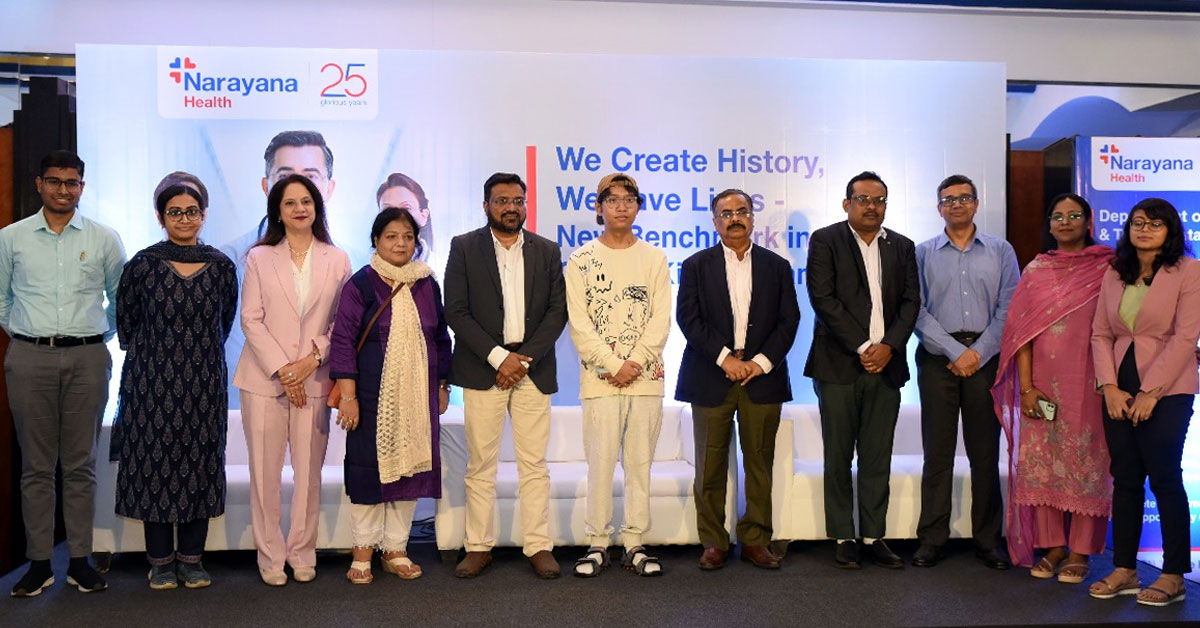
Kolkata: In a groundbreaking medical feat, Narayana RN Tagore Hospital, Mukundapur, has successfully performed a uniquely challenging kidney transplant on a young man from Bhutan suffering from severe Factor VII deficiency — one of the rarest genetic bleeding disorders in the world, occurring in just one in five million people. This is the first successful transplant globally where both the recipient and the donor carried the same rare genetic defect, marking an unprecedented milestone in the history of renal transplantation.
With no other compatible donor available, the patient’s father—also a carrier of the same genetic abnormality—emerged as the only option. This remarkable circumstance posed a complex ethical and clinical dilemma. Following extensive multidisciplinary evaluations and risk assessments, the transplant was cleared and carried out with meticulous precision by a coordinated team of specialists.
Speaking about the extraordinary nature of the case, Dr. Deepak Shankar Ray, Consultant & Chief Nephrologist (Renal Transplant Programme), Narayana RN Tagore Hospital, said,
“This case tested the very limits of medical coordination and surgical discipline. We were operating on a patient who could have suffered fatal bleeding even from minor trauma. Every stage — from anaesthesia to the final suture — required real-time monitoring of clotting parameters. The success of this surgery reflects impeccable teamwork, disciplined planning, and the family’s unwavering trust. We extend special acknowledgment to Dr. Tarshid Ali Jahangir from the Surgical Team and Dr. Titisa Sarkar Mitra from the Anaesthesiology Team for their vital contributions.”
Explaining the rarity of the condition, Dr. Sisir Kumar Patra, Consultant – Haematology, added,
“Severe Factor VII deficiency is so uncommon that only about one in fifty lakh people globally are affected. Managing such patients requires a razor-thin margin of safety — inadequate Factor VII can cause catastrophic bleeding, while excess levels can trigger dangerous clotting. This case demanded minute-by-minute adjustments throughout the surgery and recovery. We are delighted that both father and son are doing well.”
The post-operative course included a brief episode of paralysis in the patient due to a minor clot, but he was successfully treated through coordinated care by the nephrology, neurology, and haematology teams. His kidney function has stabilised, and he is now leading a healthy life post-transplant.
Expressing pride in this landmark achievement, Abhijit C.P., Director & Cluster Head – Kolkata and Corporate Growth Initiative, Narayana Health, East, said,
“Our doctors didn’t just perform a rare surgery — they managed one of the most complex and severe cases imaginable. They gave a young man a new lease on life while ensuring his father’s safety. This accomplishment places Eastern India prominently on the global map of advanced clinical excellence.”
Adding his appreciation, R. Venkatesh, Group COO, Narayana Health, remarked,
“At Narayana Health, we strive to push the boundaries of medical possibility while upholding the highest ethical standards. This successful transplant is a testament to multidisciplinary collaboration, global best practices, and compassionate care that transcends borders. We are immensely proud of our clinical team and deeply grateful to the family for their trust.”
The case is already attracting significant attention from medical experts worldwide due to its rarity, complexity, and the ethical considerations involved.