
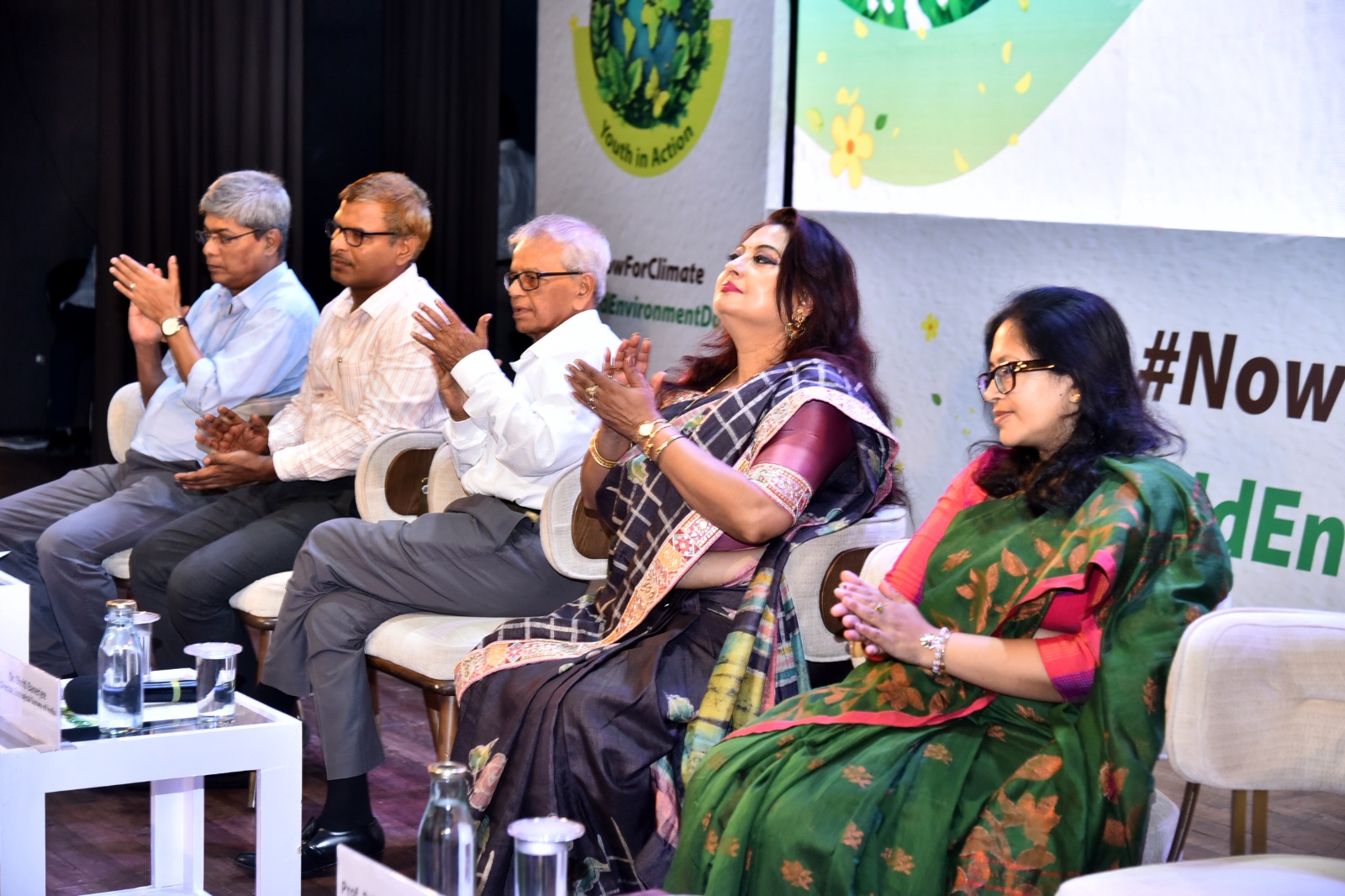
Kolkata: Students from colleges and universities across West Bengal shared ideas and discussed their role in tackling climate change at a programme organised to mark World Environment Day.
The event, themed “Inspired by Nature. For Climate. For Our Future,” was organised by UNICEF in Kolkata on Thursday to encourage youth-led climate action initiatives in the state.
During the interactive session, students raised concerns about environmental challenges and explored practical solutions. Students of St. Xavier’s College, Atika Sk and Shantam Dey, highlighted the growing environmental impact of artificial intelligence (AI), noting that AI technologies consume significant amounts of energy and water.

Atika called for regulations on the unnecessary use of AI where environmental costs outweigh benefits. Shantam stressed the importance of taking small but meaningful steps to reduce environmental degradation, saying that educational institutions and workplaces should adopt measures to address climate-related challenges.
Addressing the gathering, Dr. Dhriti Banerjee, Director of the Zoological Survey of India, said that while industrialisation and technological advancement are inevitable, they must be sustainable and environmentally responsible.
“Industrialisation and AI will happen. But it has to be sustainable and green. Technology must improve in such a way that the carbon footprint goes down and we are able to survive,” she said.
Dr. Banerjee also highlighted India’s rich biodiversity, noting that the country is home to more than 1,05,000 living species. She urged young people to spread awareness about biodiversity conservation and protect habitats from destruction.
“Every species plays a vital role in maintaining ecological balance. When you see activities such as indiscriminate tree felling, raise your voice and build awareness to prevent habitat loss,” she said.
Students Daksha Banerjee and Arpita Lala from Netaji Nagar College for Women questioned whether a carbon tax could help curb emissions and how young people could contribute to environmental protection through zero-waste practices in a developing economy like India.
Responding to the query, solar energy expert Dr. S.P. Gon Choudhury said that implementing a carbon tax in India may not be practical due to its potential impact on economically weaker sections by increasing electricity costs. Instead, he advocated greater emphasis on reusing resources to reduce global warming.
UNICEF West Bengal Chief Dr. Monjur Hossain described young people as “climate champions” and encouraged them to become active participants in environmental protection.
“You are not merely victims of climate change; you are agents of change. We want to hear your ideas and solutions. Use your creativity and positive energy to address local environmental challenges,” he told the students.
Dr. H.R. Biswas, senior scientist at the India Meteorological Department (IMD), highlighted the increasing frequency of climate-related disasters.
“Nearly 75 per cent of natural disasters are now occurring due to extreme weather events,” he said, adding that India continues to contribute significantly to global climate monitoring efforts through the World Meteorological Organization.
The programme was moderated by environmental journalist Jayanta Basu. Prof. Tuhin Ghosh of Jadavpur University discussed the growing threats posed by cyclones, sea-level rise and storm surges to nearly 50 lakh residents of the Sundarbans region, located about 100 kilometres from Kolkata.
Prof. Pritha Bhattacharya of the University of Calcutta urged students to adopt recycling and reuse practices as part of their daily lives to help conserve the environment.
The programme concluded with a call for greater youth participation in climate action, highlighting the importance of awareness, innovation and sustainable living in addressing the climate crisis.


